Catholic AI & Human Dignity
カトリックとAI、人間の尊厳
Evaluating AI systems so that technology remains a servant of the human person. Guided by Thomistic anthropology and Magnifica Humanitas.
トマス・アクィナスの人間論と回勅『マニフィカ・フマニタス』に導かれ、技術がいつまでも人間に仕えるものであり続けるよう、AIシステムを評価します。
Artificial intelligence is increasingly used in education, healthcare, pastoral work, and daily communication. Before adopting or recommending any AI system, Catholic institutions need a clear way to ask: Does this system respect the human person?
人工知能は、教育、医療、司牧、日々のコミュニケーションの場で、ますます使われるようになっています。カトリックの施設や団体がAIシステムを導入したり勧めたりする前に、「このシステムは人間を尊重しているだろうか」と明確に問いかけるための方法が必要です。
The Hylomorphic Audit Checklist v2.10 is a practical discernment tool grounded in Thomistic anthropology and the vision of Magnifica Humanitas. It helps evaluate AI systems as human-made artifacts, not as persons or moral agents, and checks whether they support human dignity, responsibility, and the common good.
ハイロモーフィック監査チェックリスト v2.10は、トマス・アクィナスの人間論と『マニフィカ・フマニタス』のビジョンに基づく、識別のための実践的なツールです。AIシステムを人格や道徳的主体としてではなく、人間が作った人工物として評価し、それが人間の尊厳、責任、共通善を支えているかどうかを確かめます。
Languages available in the tool: English · Italiano · Español · 日本語. This tool is offered as a prototype for careful institutional use. It supports discernment; it does not replace the Magisterium or local ecclesiastical authority.
ツールで利用できる言語:English・Italiano・Español・日本語。このツールは、施設や団体で慎重に用いるための試作版(プロトタイプ)として提供されています。識別を助けるものであり、教会の教導職や各地の教会の権威に代わるものではありません。
Why it matters now
今、なぜ大切なのか
今、なぜ大切なのか
AI Agents, Power, and the Protection of Human Dignity
AIエージェント、力、そして人間の尊厳を守ること
Artificial intelligence is no longer only a passive tool for search or drafting text. Increasingly, AI agents can plan steps, call other systems, write and execute code, manage workflows, and act across digital environments with limited human supervision. As these systems gain practical autonomy—even while remaining technical artifacts in principle—the risk grows that human judgment, responsibility, and dignity are sidelined.
人工知能は、もはや検索や文章作成のための受け身の道具にとどまりません。AIエージェントは、手順を計画し、ほかのシステムを呼び出し、コードを書いて実行し、業務の流れを管理し、人間による監督が限られたまま、デジタル環境の中で行動するようになっています。こうしたシステムが実際上の自律性を強めるにつれて(原理的には技術的な人工物であり続けるとしても)、人間の判断、責任、尊厳が脇に追いやられる危険が大きくなっています。
Without clear governance, several pressures intensify:
明確なガバナンスがなければ、次のような圧力が強まります。
- Substitution of judgment — machines used to decide outcomes that belong to human conscience and accountability
判断の置き換え:人間の良心と説明責任に属する事柄の結論を、機械に決めさせること - Anthropomorphic confusion — language that treats AI as if it were a person, moral agent, or bearer of rights
擬人化による混乱:AIを人格、道徳的主体、権利の担い手であるかのように扱う言葉づかい - Opaque action chains — agentic systems whose intermediate steps are hard to audit or interrupt
不透明な行動の連鎖:途中の手順を監査したり止めたりすることが難しいエージェント型システム - Unequal access and control — powerful capabilities concentrated in a few hands, or unavailable to those most in need
アクセスと管理の不平等:強力な能力が少数の手に集中し、最も必要としている人々には届かないこと - False promises of transcendence — narratives that treat present humanity as incomplete and technology as salvation
超越の偽りの約束:今の人間を未完成なものとみなし、技術を救いとして扱う物語
Catholic teaching insists that every human person has intrinsic dignity—not because of efficiency or data profile, but because the person is created in the image of God. AI may assist human work; it must not replace moral responsibility, weaken truthfulness, or redefine the human person as an obsolete “version 1.0.”
カトリックの教えは、すべての人間が固有の尊厳を持っていると強く教えています。それは効率やデータ上のプロフィールによるのではなく、人間が神の似姿として造られているからです。AIは人間の働きを助けることはできますが、道徳的責任に取って代わったり、誠実さを損なったり、人間を時代遅れの「バージョン1.0」として定義し直したりしてはなりません。
This page offers a practical response: the Hylomorphic Audit Checklist, a prototype instrument for evaluating AI systems in light of human dignity, responsible oversight, and the common good.
このページでは、その実践的な応答としてハイロモーフィック監査チェックリストをご紹介します。人間の尊厳、責任ある監督、共通善に照らしてAIシステムを評価するための、試作段階の評価手段です。
Hylomorphic Audit Checklist v2.10
ハイロモーフィック監査チェックリスト v2.10
ハイロモーフィック監査チェックリスト v2.10
A Catholic prototype tool to check whether AI systems respect human dignity. It treats AI as a human-made artifact, not a person or moral agent.
AIシステムが人間の尊厳を尊重しているかどうかを確かめるための、カトリックの試作ツールです。AIを人格や道徳的主体ではなく、人間が作った人工物として扱います。
| Level レベル |
Focus 重点 |
|---|---|
| 1 |
Ontological classification — what the system is |
| 2 |
Human faculties and relationships — oversight, judgment, encounter |
| 3 |
Ethical and societal alignment — access, liability, Red Lines |
| Virtues 対神徳 |
Faith, Hope, Charity |
This instrument supports discernment. It does not replace the Magisterium or local ecclesiastical authority. Scoring is a provisional calibration for critique and pilot use.
この評価手段は識別を助けるものであり、教会の教導職や各地の教会の権威に代わるものではありません。採点は、批判的な検討と試験導入のための暫定的な目安です。
Paper overview
論文の概要
論文の概要
Magnifica Humanitas in Practice: A Thomistic Framework for Catholic AI Governance Neil Day · v2.10, revised 25 October 2026 (first edition June 2026)
ニール・ディ・v2.10(2026年10月25日改訂、初版2026年6月)
ニール・ディ・v2.10(2026年10月25日改訂、初版2026年6月)
This paper proposes a concrete Catholic framework for AI governance in response to Pope Leo XIV’s encyclical Magnifica Humanitas. Technical and procedural standards are necessary, but incomplete without a clear account of the human person and of what an AI system is.
この論文は、教皇レオ十四世の回勅『マニフィカ・フマニタス』に応えて、AIガバナンスのための具体的なカトリックの枠組みを提案するものです。技術的・手続き的な基準は必要ですが、人間(人格)とは何か、そしてAIシステムとは何であるかについて明確に説明できなければ、十分とはいえません。
Core claim
中心となる主張
AI systems are human-made artifacts with accidental form. They are not persons, do not possess a rational soul, and cannot bear moral agency or legal personhood. Governance must keep AI subordinate to human judgment and ordered to the common good.
AIシステムは、偶有形相を持つ、人間が作った人工物です。人格ではなく、理性的霊魂を持たず、道徳的主体性や法的人格を担うことはできません。ガバナンスは、AIを常に人間の判断のもとに置き、共通善へと秩序づけなければなりません。
Two operational contributions
二つの実践的な貢献
- Catholic AI Standards Working Group (CASWG) — a proposed collaborative structure for shared criteria, pilots, and review
カトリックAI基準作業部会(CASWG):共通の基準、試験導入、審査のために提案されている協働の体制 - Hylomorphic Audit Checklist — structured evaluation across ontology, relationships, societal ends, and theological virtues, with explicit Red Line safeguards
ハイロモーフィック監査チェックリスト:存在論、関係性、社会的な目的、対神徳にわたる構造化された評価。明確なレッドラインによる歯止めを備えています
Red Line concerns
レッドラインとなる懸念
Attribution of personhood or moral status to AI; treating biological humanity as provisional; mind-uploading / “digital soul” claims; unconstrained autonomous replication; technological substitutes for Christian hope and human responsibility.
AIに人格や道徳的地位を認めること。生物としての人間を暫定的な存在とみなすこと。マインドアップロードや「デジタルの魂」の主張。制約のない自律的な自己複製。キリスト教的希望と人間の責任を技術で置き換えようとすること。
Status
現状
A prototype governance rubric for scholarly critique and pilot use—explicitly subordinate to the Magisterium. Endorsed by Professor Tad Gonsalves (Sophia University, Tokyo). Related dialogue includes participation in the Builders AI Forum, Pontifical Gregorian University, Rome (5–6 November 2026).
学術的な批判的検討と試験導入のための、試作段階のガバナンス評価基準であり、明確に教会の教導職のもとに置かれています。ゴンサルベス タッド教授(上智大学、東京)の推薦を受けています。関連する対話として、ローマの教皇庁立グレゴリアナ大学で開かれるビルダーズAIフォーラム(2026年11月5日〜6日)への参加があります。
Read or Download the full paper (PDF)
論文全文を読む・ダウンロードする(PDF)
論文全文を読む・ダウンロードする(PDF)
Figures
図
図
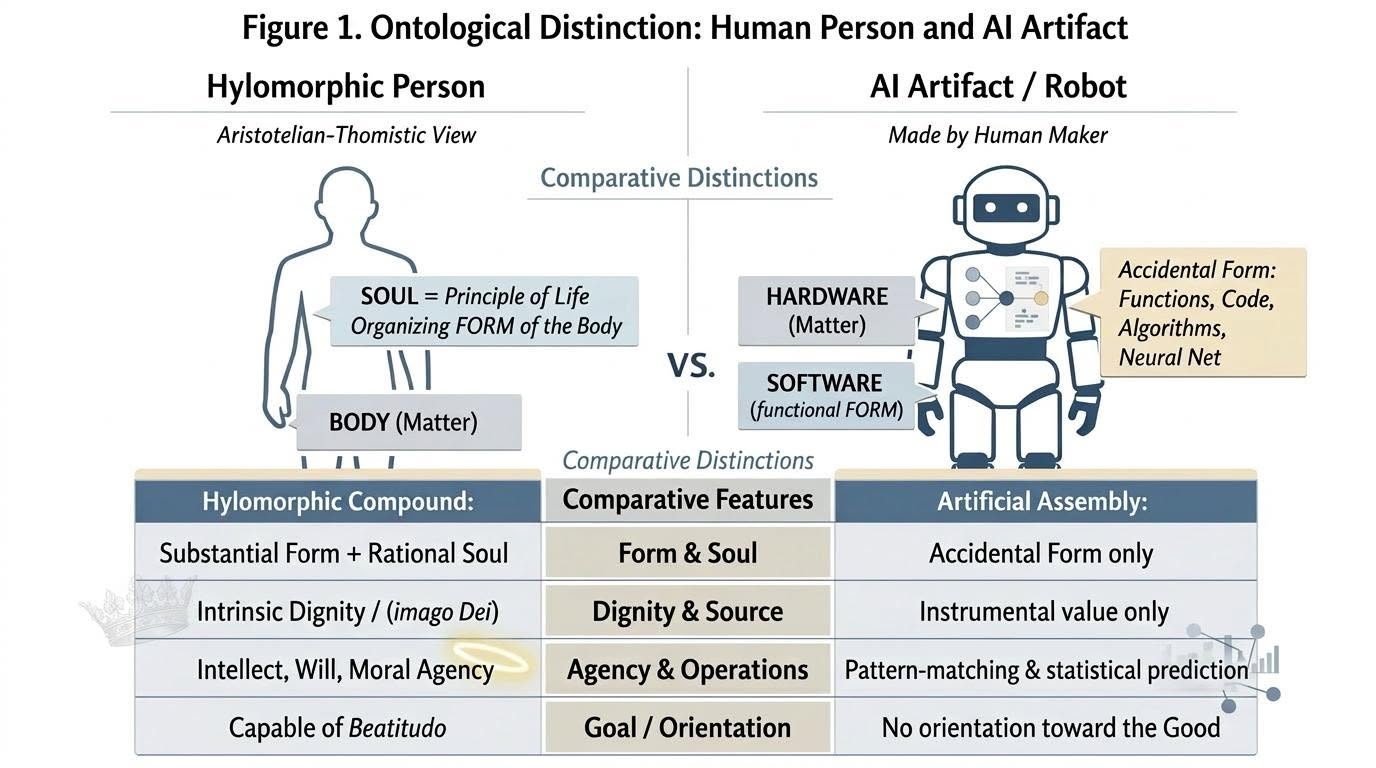
Figure 1: Person and artifact
図1:人格と人工物
The human person (body–soul unity, moral agency) is distinguished from AI as a human-made tool. Governance begins with this ontological boundary.
人間(身体と霊魂の一致、道徳的主体性)は、人間が作った道具であるAIとは区別されます。ガバナンスは、この存在論的な境界線から始まります。
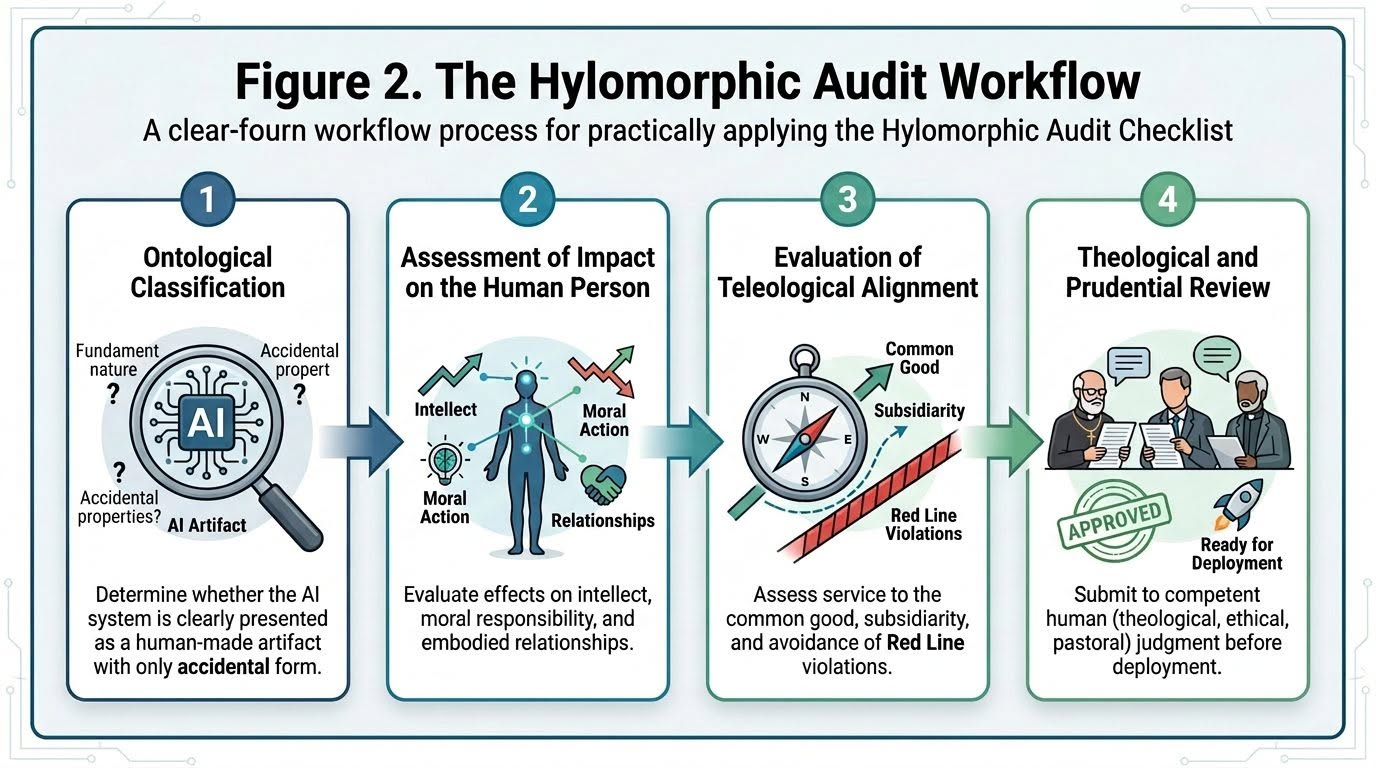
Figure 2: Audit workflow
図2:監査の流れ
From classification and evidence → scoring → Red Line review → discernment for pilot or institutional use.
分類と根拠の確認 → 採点 → レッドラインの審査 → 試験導入や施設・団体での利用に向けた識別。
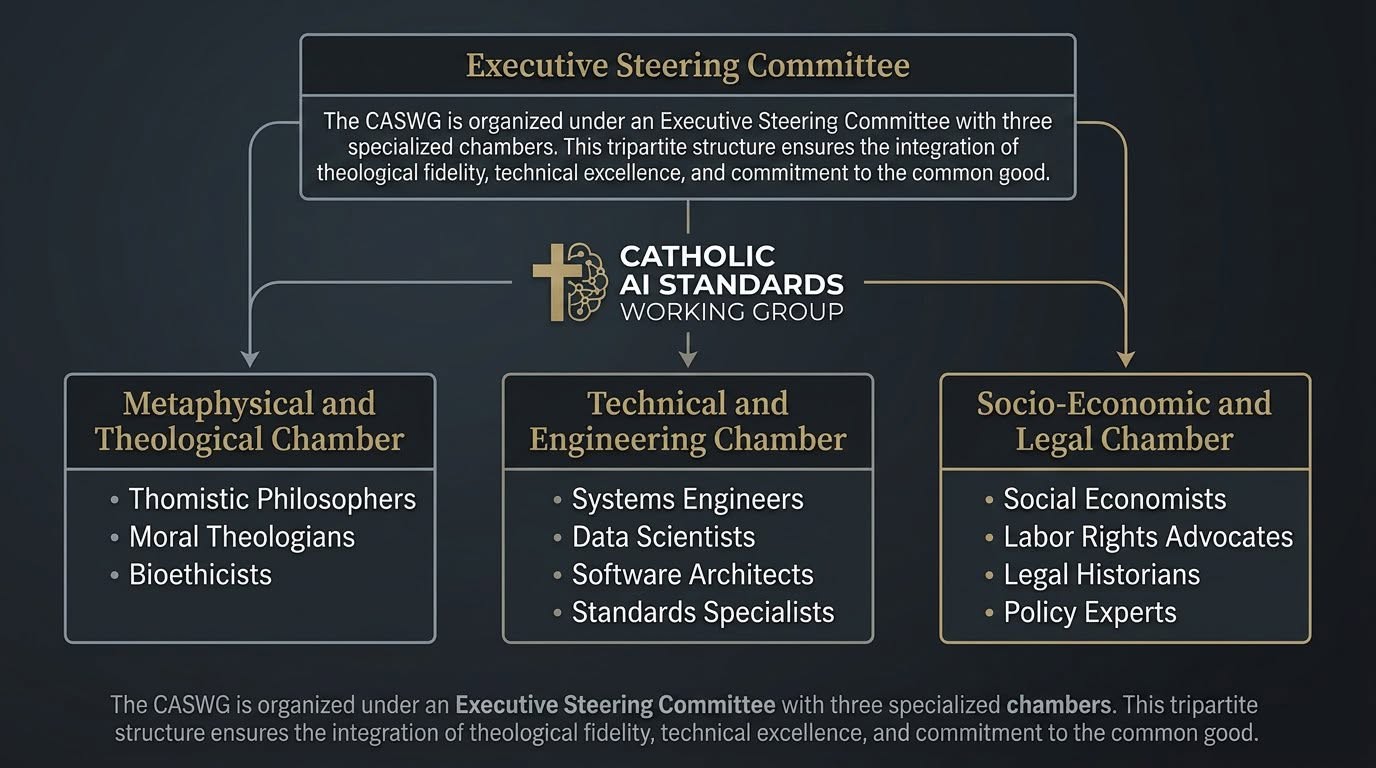
Figure 3: CASWG review structure (proposed)
図3:CASWGの審査体制(案)
Theological, technical, and social–legal perspectives work together so that criteria serve human dignity and the common good.
神学、技術、社会・法律の観点が協力し、基準が人間の尊厳と共通善に奉仕するようにします。
Citation & license
引用とライセンス
Day, Neil. Magnifica Humanitas in Practice: A Thomistic Framework for Catholic AI Governance. v2.10, revised 25 October 2026 (first edition June 2026). https://www.evangeliinetworkjapan.org/catholic-ai-human-dignity/
本論文を引用される際は、上記のとおり表記してください(著者:ニール・ディ、v2.10・2026年10月25日改訂、初版2026年6月)。
CASWG Standards Charter and Manifesto CASWG基準憲章およびマニフェスト
Draft for consultation, October 2026. Prepared for the Builders AI Forum (BAIF), Rome, 5–6 November 2026. The Charter proposes the Catholic AI Standards Working Group as an expert-consensus standards body on the MPEG/ISO model, grounded in Catholic anthropology and the Hylomorphic Audit Checklist v2.10.
2026年10月 意見募集用草案。ローマで2026年11月5〜6日に開催されるBuilders AI Forum(BAIF)のために作成されました。本憲章は、カトリックAI基準作業部会(CASWG)を、カトリックの人間観とヒロモルフィック監査チェックリストv2.10に基づき、MPEG/ISOのモデルに倣った専門家の合意による基準策定機関として提案するものです。
You are invited to download and review it. Scholars, clergy, technologists and Catholic institutions are warmly invited to read the draft and send comments to enjsummit@gmail.com.
ぜひダウンロードしてご一読ください。研究者、聖職者、技術者、カトリック諸機関の皆さまからのご意見を enjsummit@gmail.com までお寄せください。
Download PDF ↓ PDFをダウンロード Download Word ↓ Word版をダウンロード
This draft does not claim magisterial authority and remains subject to review by the Theological Review Board and adoption by the Steering Committee. / 本草案は教導権的権威を主張するものではなく、神学審査委員会の審査および運営委員会による採択を経るものです。